
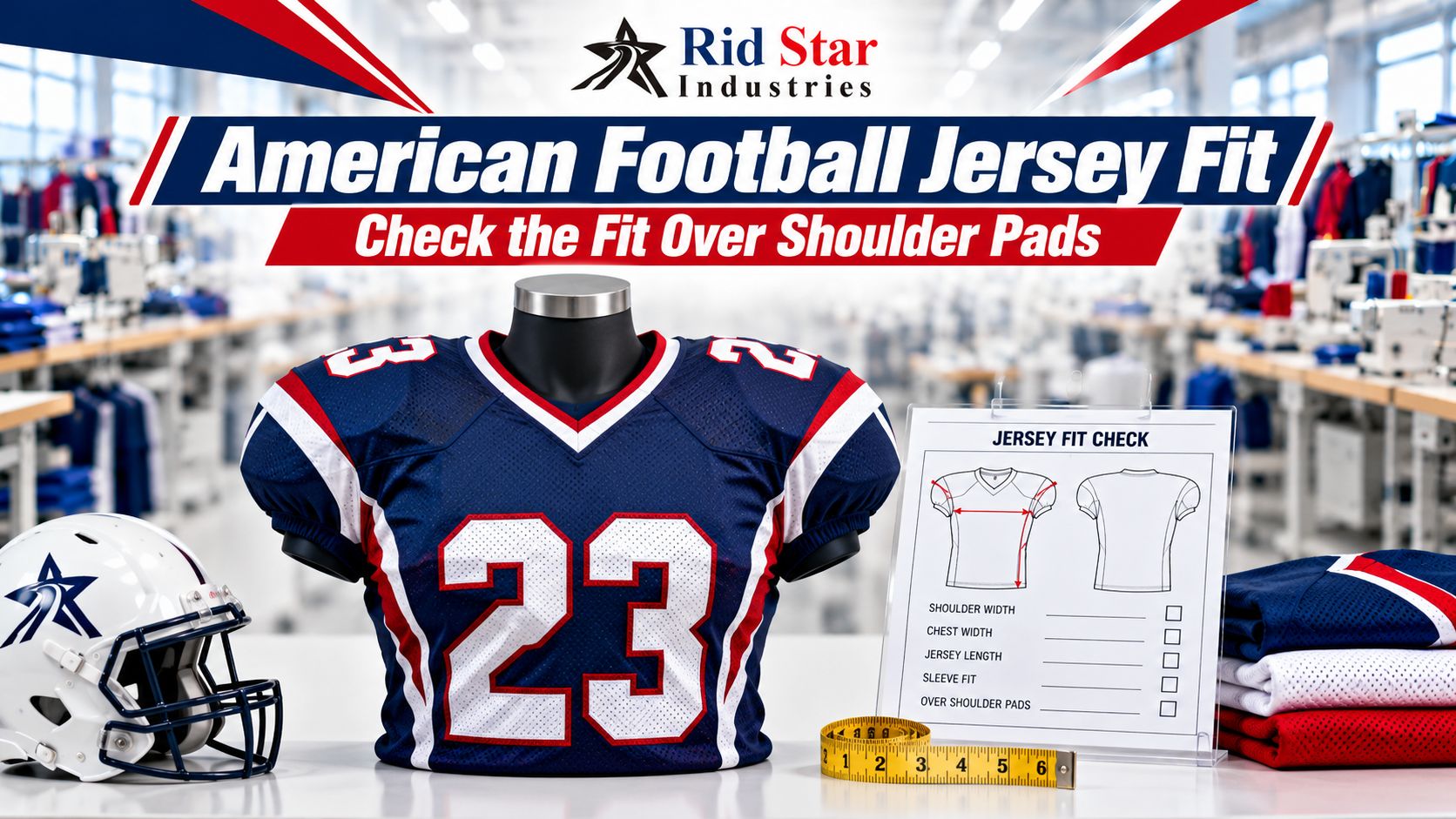
American Football Jersey Fit: What to Check Over Shoulder Pads
American football jersey fit should be assessed with the equipment players will wear. A jersey that looks correct without shoulder pads may pull across the upper body, restrict movement or sit differently once the equipment is underneath.
For clubs, schools, distributors and teamwear brands, the aim is to approve a garment specification that works for the intended players and equipment. A familiar size label or a good-looking mockup is only part of that decision.
This guide explains what to check when reviewing a custom jersey sample over shoulder pads, and how to turn the findings into clear manufacturing instructions.
Confirm the Jersey’s Intended Use
Tell the manufacturer whether the garment is for tackle football, non-contact activities or supporter wear.
A replica jersey designed for casual use should not be treated as a reference for a jersey intended to fit over shoulder pads. Likewise, a practice garment may have different construction and decoration requirements from a game jersey.
State whether the order covers youth players, adults or both. Describe the intended silhouette and provide a reference garment if you have one, explaining which features you want to retain.
Confirm the equipment used by the team. Where players wear different shoulder-pad models, discuss which examples should be included in the sample review.
The jersey review concerns the garment’s fit. Have protective equipment fitted according to its manufacturer’s instructions and your team’s equipment procedures before using it for the trial.
Understand What the Size Chart Measures
Ask whether the supplier’s chart gives body measurements or finished-garment measurements. They are not interchangeable.
A body chest circumference and a jersey’s flat chest width describe different things. Confirm the units, measurement points and whether the fabric is measured relaxed or stretched.
Ask whether the recommended sizing already accounts for wearing shoulder pads. Do not automatically add a fixed allowance or move every player up a size.
Record the relevant garment dimensions, which may include:
- Chest width at the agreed measurement point.
- Body length from a defined shoulder or neckline point.
- Shoulder and upper-body dimensions.
- Sleeve length and opening.
- Hem width.
Use the manufacturer’s measurement diagram so both parties measure the same locations. Keep the intended tolerances with the specification rather than deciding what is acceptable after the sample arrives.
Try the Sample Over the Actual Equipment
Conduct the fitting with the player’s properly fitted shoulder pads, usual base layer and intended football trousers.
Start with the player standing naturally. Review the front, back and side views before asking them to move.
Check how the jersey settles over the pads and whether it can be put on and removed without forcing the garment or stressing its seams.
Look for concentrated pulling across the chest, upper back and underarm areas. Also note excess fabric that gathers or hangs away from the intended shape.
A close fit and a restrictive fit are different observations. Explain where the problem occurs rather than relying on comments such as “too tight” or “too loose.”
If the sample does not work with the equipment, discuss the jersey size or pattern with the manufacturer. Do not alter the protective equipment to compensate for the garment.
Check Movement, Neckline and Sleeve Openings
Ask the player to perform comfortable, non-contact movements relevant to their role, such as reaching forward, raising the arms and rotating the torso.
Observe whether the jersey pulls sharply at the neckline, catches around the pad edges or limits an otherwise comfortable movement.
Review the sleeve openings and cuffs. They should work with the proposed equipment and sleeve design without creating unwanted pressure or excessive loose material.
Check the upper-body seams while the player moves. Record where fabric or stitching appears strained and whether the jersey returns to its intended position afterwards.
Photograph the issue from a useful angle and describe the movement that produces it. For example: “The underarm seam pulls when the player reaches forward while wearing the recorded pad model.”
These observations give the manufacturer a more useful starting point than asking for the entire garment to be made larger.
Assess Jersey Length with the Trousers
Review body length with the trousers the player will use, including the intended tucked position.
Check the front and back hem while standing, reaching and bending. Note whether the jersey pulls out, bunches excessively or requires repeated adjustment.
Do not select extra length without considering the rest of the fit. A longer body does not necessarily resolve a restricted shoulder or underarm area.
Confirm any applicable competition requirements for how the jersey must be worn. Provide these requirements to the manufacturer before approving the final length and hem construction.
Record the finished measurement and the observed fit together. This makes it easier to distinguish a sample outside the specification from a specification that needs revising.
Review Fabric and Construction at the Problem Area
When a sample does not fit as intended, discuss whether the issue comes from the pattern, fabric, panel arrangement or finishing.
Ask the manufacturer to identify the materials used in the body, shoulders, sleeves and any stretch panels. Avoid assuming that the entire jersey uses one fabric.
A request for “more stretch” should identify where it is needed and what movement the current sample restricts. Review the proposed change on a revised sample where necessary.
For help preparing the material brief, our guide to choosing fabric for sports uniforms explains the specifications to discuss with a manufacturer.
Inspect the construction around the neckline, armholes and panel joins. Note open seams, uneven finishing or visible strain, and agree how corrections will be verified.
Check Artwork While the Jersey Is Worn
Approve decoration placement on the worn garment as well as on the flat artwork.
Shoulder pads change the shape over which the design is displayed. Check how numbers, names and logos sit across the chest, back, shoulders and sleeves.
Look for details that become distorted, obscured by folds or positioned awkwardly near seams. Review the proposed decoration method on the actual material.
Ask the competition organiser for the applicable number, logo and placement requirements. Do not apply one league’s specifications to every team order.
Check artwork across the intended size range. A design that fits one sample size may need a planned adjustment on smaller garments.
Keep the approved artwork dimensions and placement references with the final garment specification.
Approve the Size Range and Record Corrections
One successful fitting does not confirm every size in the order. Agree on sample sizes that represent the youth and adult ranges, body types and equipment combinations relevant to the team.
Use a fitting record for each sample:
| Record | Details to include |
|---|---|
| Sample | Style, size, date and version |
| Player | Reference and relevant body measurements |
| Equipment | Shoulder-pad model and size |
| Garment measurements | Results taken using the agreed method |
| Fit observations | Location of pulling, looseness or movement restriction |
| Required correction | Specific change for the manufacturer to assess |
| Approval | Accepted, pending revision or approved for specified details only |
Keep measurement errors separate from preference changes. A sample that differs from the approved chart requires a different response from a request to change the intended fit.
After revisions, confirm the final specification before submitting the complete size breakdown. Retain the approved sample and fitting records for production checks and future orders.
Discuss Custom American Football Jerseys with Rid Star
Rid Star Industries manufactures custom American football uniforms for B2B buyers, including clubs, schools, brands and distributors.
Our custom American football uniform manufacturing page outlines the product and customisation options.
Our minimum order quantity is 10 pieces/sets. Share the intended use, size range, equipment details, artwork and any reference garment or measurement chart so the proposed specification can be discussed.
Include your sample-review requirements and required arrival date when submitting an enquiry.