
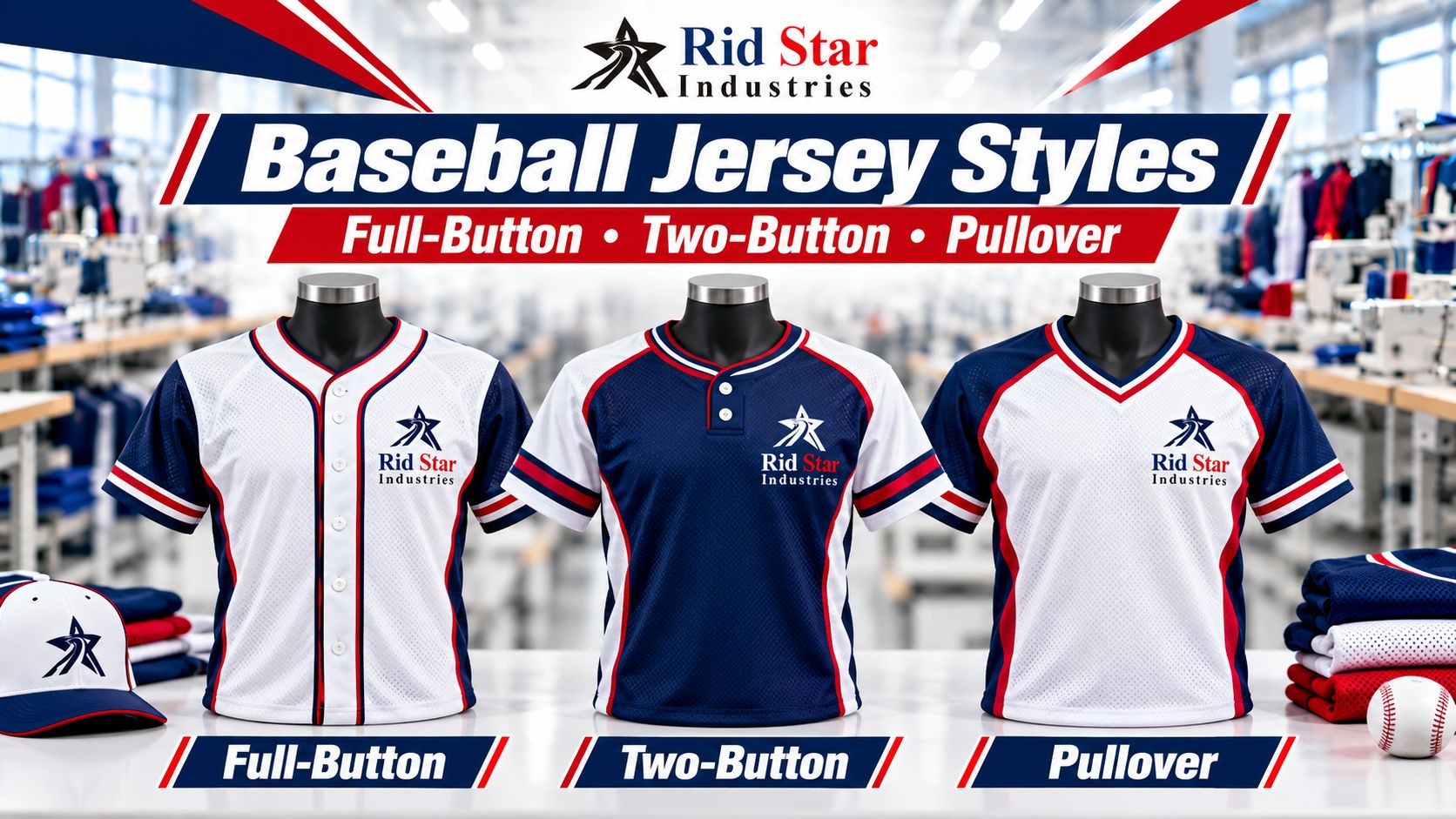
Baseball Jersey Styles: Full-Button vs Two-Button vs Pullover
Choosing between baseball jersey styles affects more than the appearance of a team uniform. The front opening changes how players put the garment on, how chest lettering is arranged and which construction details need attention during sampling.
Full-button, two-button and pullover jerseys can all be considered for custom teamwear. The right choice depends on the intended use, artwork, fit and complete order specification.
This guide helps clubs, schools, apparel brands and distributors compare the three options before approving a design for production.
Understand the Three Front Styles
A full-button jersey opens down the front. Its overlapping button band, also called the placket, becomes part of both the construction and the artwork layout.
A two-button jersey has a short opening at the neckline. The lower front remains closed, and the garment is pulled over the head.
For this comparison, a pullover means a jersey without a functioning button opening, using a neckline such as a crew neck or V-neck.
Terminology can vary between suppliers. Some button-look designs have only a short functioning opening, so provide a drawing or reference photograph showing exactly what you want.
| Style | Front construction | Main point to review |
|---|---|---|
| Full-button | Opening down the front | Button-band alignment, gaping and artwork crossing the opening |
| Two-button | Short neckline opening | Placket depth and its relationship to chest lettering |
| Pullover | No functioning button opening | Neckline access, recovery and artwork placement |
Rid Star Industries manufactures all three styles. Specify the required construction when requesting a quotation rather than relying on the word “baseball jersey” alone.
Plan Chest Lettering Around the Opening
Place the actual team name, crest and front number onto the proposed garment pattern before approving the design.
On a full-button jersey, lettering or graphics crossing the centre front must account for the overlapping fabric. Ask the manufacturer how the design will appear when the jersey is fastened.
Review the closed garment for interrupted letters, uneven spacing or parts of the design hidden beneath the overlap. If the jersey includes piping or stripes, check their alignment at the same time.
A two-button opening occupies less of the front, but its lower edge can still interfere with high chest lettering. Show the opening depth and artwork position together.
A pullover removes the button-band interruption from the front design. However, neckline shape, panel seams and garment size still affect the available space.
For every style, approve artwork on the smallest relevant size as well as the main sample size. Do not assume one lettering width will work across the entire range.
Compare Fit and Movement Using the Same Conditions
Try samples with the base layer players expect to wear and with the intended baseball trousers.
Check comfortable reaching, torso rotation and throwing movements. Record pulling across the back, restriction around the armholes or excessive fabric gathering at the waist.
On a full-button sample, look for gaps between buttons when the wearer moves. Discuss whether the cause is garment width, button spacing, the shape of the front or another construction detail.
On a two-button or pullover sample, check that the neckline allows the garment to be put on and removed comfortably. Inspect whether the opening returns to its intended shape after normal use.
Review body length in the intended tucked or untucked position, subject to the team’s competition requirements.
The front style alone does not determine fit. Compare the measurement charts and patterns rather than assuming the same size label will fit identically in all three versions.
Specify Buttons, Necklines and Finishing
For buttoned jerseys, record the button colour, dimensions and placement. Confirm which buttons function and how the buttonholes will be finished.
Inspect the sample for secure attachment, clean buttonholes and an opening that lies as intended when fastened.
For a two-button design, check the bottom of the short placket for uneven stitching, puckering or an uncomfortable bulky finish.
For a pullover, specify the neckline shape and finishing material. Review the seam against the skin and check the neckline after putting the garment on and taking it off.
If contrast piping is part of the design, show where it starts, ends and passes around the opening. Include sleeve and collar details in the same specification.
Use close-up photographs to record any corrections, identifying the exact location and the result you want the manufacturer to assess.
Keep Fabric Selection Separate from Front Style
A full-button jersey is not automatically heavier or more durable than a pullover. Compare the specified material and construction rather than drawing conclusions from the opening alone.
Ask for the fabric composition, construction and GSM for each option. If different materials are proposed, assess how that affects feel, coverage, movement and the intended decoration.
Our guide to choosing the right fabric for sports uniforms explains the material details to settle before approving a sample.
Tell the manufacturer whether the jersey is intended for games, training or supporter use. Evaluate the material against that purpose.
If you want a fair comparison between front styles, ask whether samples can use the same agreed fabric. Where that is not practical, have the differences clearly identified.
Confirm the Decoration Method and Its Placement
Send the complete artwork when discussing sublimation, embroidery, screen printing or heat transfer.
Ask how the proposed method will work around the button band, neckline and seams. A digital mockup should be followed by an appropriate physical sample or decoration proof where needed.
For embroidery, review the backing and finish inside the garment. For printed details, check their position, edges and appearance on the proposed fabric.
On a full-button design, assess any chest decoration with the jersey fastened. Confirm that the decoration does not obstruct the buttonholes or interfere with opening and closing the garment.
Keep front numbers, back numbers and player names clearly identified in the artwork files. Approve their dimensions and positions for the relevant sizes.
Do not assume that a decoration method included in one style’s quotation is also included in another.
Compare Quotations for the Same Package
Request prices using the same quantities, fabric requirements, size breakdown and decoration details.
Clarify whether each offer covers jerseys only or a complete uniform package. Identify any trousers, labels, individual packaging and other components separately.
Ask the supplier to explain price differences between the styles. Buttons, opening construction, finishing and artwork handling may affect the quotation, but no style should be assumed to be the cheapest without reviewing the actual offer.
Confirm sample costs and what happens if the front style changes after sampling. A change from pullover to full-button may also require revisions to the artwork and garment specification.
Rid Star’s minimum order quantity is 10 pieces/sets. Share the proposed style, colour and size breakdown so available combinations can be confirmed.
Approve a Finished Garment Before Bulk Production
Review the sample as a complete jersey, including the intended opening, decoration, labels and finishing.
Use this short style-specific check:
- Full-button: fasten the jersey and inspect front alignment, lettering and gaps during movement.
- Two-button: inspect the short opening, its lower edge and clearance around the chest artwork.
- Pullover: assess neckline access, shape and comfort after putting the jersey on and removing it.
- All styles: check fit, measurements, body length, sleeve movement and decoration placement.
Record corrections against the sample version. If a change affects the fit or front construction, agree whether a revised physical sample is needed.
Keep the approved garment and final artwork as references for production and future orders.
Discuss Custom Baseball Jerseys with Rid Star
Rid Star Industries manufactures full-button, two-button and pullover baseball jerseys for B2B buyers, including clubs, schools, sports brands and distributors.
Visit our custom baseball uniform manufacturing page to explore the manufacturing and customisation options.
Send your preferred front style, artwork, fabric requirements, quantity and size breakdown through our quote builder. Include any reference photographs and your required arrival date so the proposed specification can be discussed.