
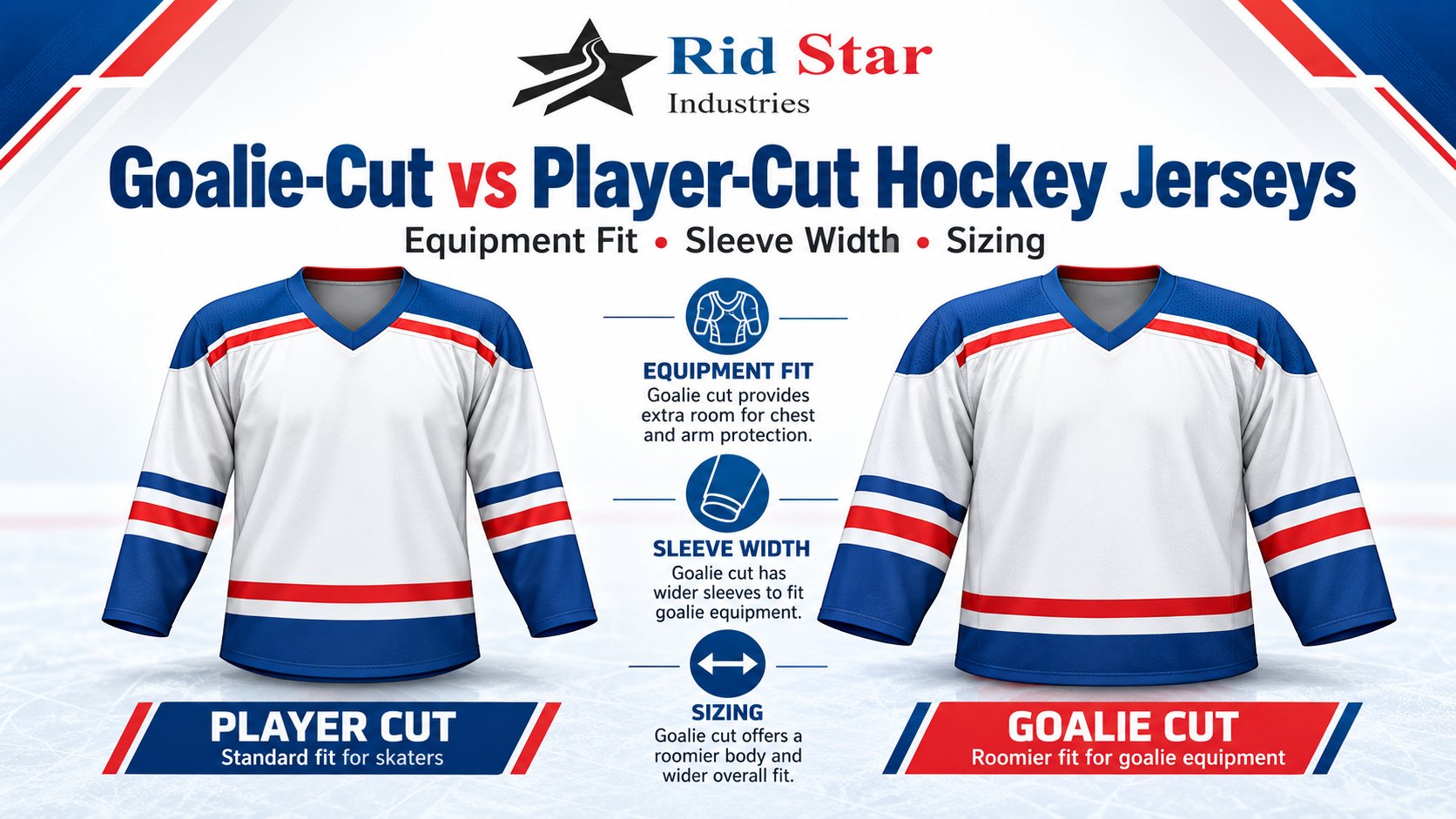
Goalie-Cut vs Player-Cut Hockey Jerseys: A Team Buyer’s Guide
A goalie-cut hockey jersey uses body and sleeve proportions intended to fit over a goalkeeper’s chest and arm protection. A regular player-cut jersey is designed around a skater’s equipment. Simply ordering a larger player size may add length without providing enough clearance around the goalie’s upper sleeves or chest.
For clubs, schools, teamwear suppliers and distributors ordering custom hockey jerseys, the practical question is whether each cut fits the intended wearer’s equipment. Compare separate measurement charts, assess samples over the actual equipment and identify player and goalie cuts clearly on the order sheet.
What Is the Difference Between Goalie Cut and Player Cut?
A player-cut hockey jersey is intended to fit over a skater’s equipment. A goalie-cut jersey uses proportions intended to accommodate a goalkeeper’s chest and arm protection.
Depending on the manufacturer and pattern, those differences can include additional body width, wider sleeves and different sleeve lengths or openings.
There is no single measurement set that applies to every jersey labelled “goalie cut.” Ask for the actual garment dimensions and compare them with the intended wearer’s equipment.
| Area to compare | Player-cut jersey | Goalie-cut jersey |
|---|---|---|
| Equipment underneath | Skater’s shoulder and elbow protection | Goalie’s chest and arm protection |
| Body shape | Proportions intended for a skater’s equipment | Proportions intended for the goalie’s equipment |
| Sleeves | Width and length suited to the player’s pads and gloves | Width, length and openings assessed around goalie arm protection and gloves |
| Size selection | Player-cut chart and fitting sample | Goalie-cut chart and fitting sample |
| Artwork | Approved on the player pattern | Checked separately on the goalie pattern |
The design can remain consistent across the team, but the underlying patterns may need to differ.
Why Sizing Up May Not Solve the Problem
Moving up through player sizes can increase several dimensions together. The jersey may become longer without providing enough room in the part of the sleeve where the goalie needs it.
Conversely, a jersey that clears the chest protector may have sleeves that extend too far or gather around the gloves.
Do not use a fixed rule such as “order two sizes larger.” Compare the proposed garment measurements and assess a sample over the actual equipment.
Also distinguish playing jerseys from fan or replica jerseys. A familiar size label from a casual jersey is not a reliable basis for an on-ice team order.
Request the Measurements That Matter
Ask the supplier for separate player and goalie measurement charts, with a diagram showing how each dimension is taken.
Useful measurements include:
- Chest width, measured flat at an agreed position.
- Body length from a clearly identified reference point.
- Sleeve length, with the starting point specified.
- Sleeve width at agreed positions.
- Sleeve-opening width.
- Bottom-opening width.
Confirm whether the chart shows body measurements or finished garment measurements. A flat chest width is not the same as a full chest circumference.
Record the units and agreed measurement tolerances. Two charts cannot be compared accurately if one measures the sleeve from the shoulder seam and another from the centre back of the neck.
A jersey that already fits well over the intended equipment can provide a useful reference. Supply its measurements and photographs rather than only its size label.
Check the Sample Over the Intended Equipment
Ask players and goalkeepers to assess the sample while wearing their usual, correctly fitted equipment.
For the goalie version, check whether the jersey can be put on and removed without excessive pulling. Look for tight areas across the chest, underarms and upper sleeves.
Then assess normal arm movements with the catcher and blocker in place. Check whether sleeve ends bunch up, catch or interfere with movement.
For player jerseys, check reaching, bending and stick-handling positions. Observe whether the jersey pulls across the shoulders or rides up excessively.
Record where a problem occurs. “Too tight” is less useful to a manufacturer than identifying the upper sleeve, chest or underarm area.
Do not alter protective equipment to make a jersey fit. Resolve garment-fit questions through the jersey specification.
For a broader approval checklist, read our guide to reviewing a custom apparel sample before bulk production.
Approve Artwork on Both Patterns
A shared team design still needs to be checked on both cuts.
Changes in body width, sleeve shape and panel layout can affect the position of stripes, shoulder details, crests and numbers. Request separate artwork proofs for player and goalie patterns.
Specify the dimensions and placement of key elements. Do not assume that the entire design should be enlarged in proportion to the garment.
Check sleeve graphics against the proposed sleeve length, particularly if the goalie version differs from the player version. Review the back name and number placement on a finished sample as well as on the flat artwork.
Confirm the relevant competition’s requirements before approving the final design.
Keep Fabric and Decoration in the Specification
“Goalie cut” describes a garment shape; it does not establish fabric quality or construction.
Confirm the proposed material, GSM, panel construction and seam finishing. If the two versions use different materials, identify those differences in the order documents.
Our guide to choosing fabric for sports uniforms explains the material questions to discuss before approving your order.
Specify the decoration method for each design element. Sublimation, embroidery, screen printing and heat transfer have different application requirements, so ask the manufacturer to confirm the proposed combination of fabric, artwork and placement.
Inspect decorated areas on the sample for their appearance, backing and feel against the equipment underneath.
Identify Goalie Jerseys Separately on the Order Sheet
Keep a separate field for jersey cut rather than placing every garment in one size list.
For example, a team order sheet should identify each wearer’s name, number, player or goalie cut, approved size, quantity and design version.
This matters when a roster contains similar size labels across different patterns. “XL” alone may not identify which garment needs to be produced.
Confirm how the supplier will label or pack the different cuts so the team can distribute them correctly. Keep the approved pattern reference for repeat orders, especially if a goalkeeper changes equipment.
If the order includes only a small number of goalie jerseys, ask how these fit within the supplier’s minimum-order requirements. Do not assume that all pattern and size combinations are automatically available under one minimum.
Discuss Your Custom Hockey Jersey Order
Rid Star Industries is a B2B custom sportswear and apparel manufacturer based in Sialkot, Pakistan.
Explore our custom ice hockey uniform manufacturing service and share your team design, quantities, size breakdown and equipment-fit requirements.
Our minimum order quantity is 10 pieces/sets. Identify player and goalie requirements separately so the available cuts, sizing and order combinations can be confirmed before production.
Include reference measurements or photographs of a well-fitting jersey where available, along with your branding, packaging and delivery requirements.