
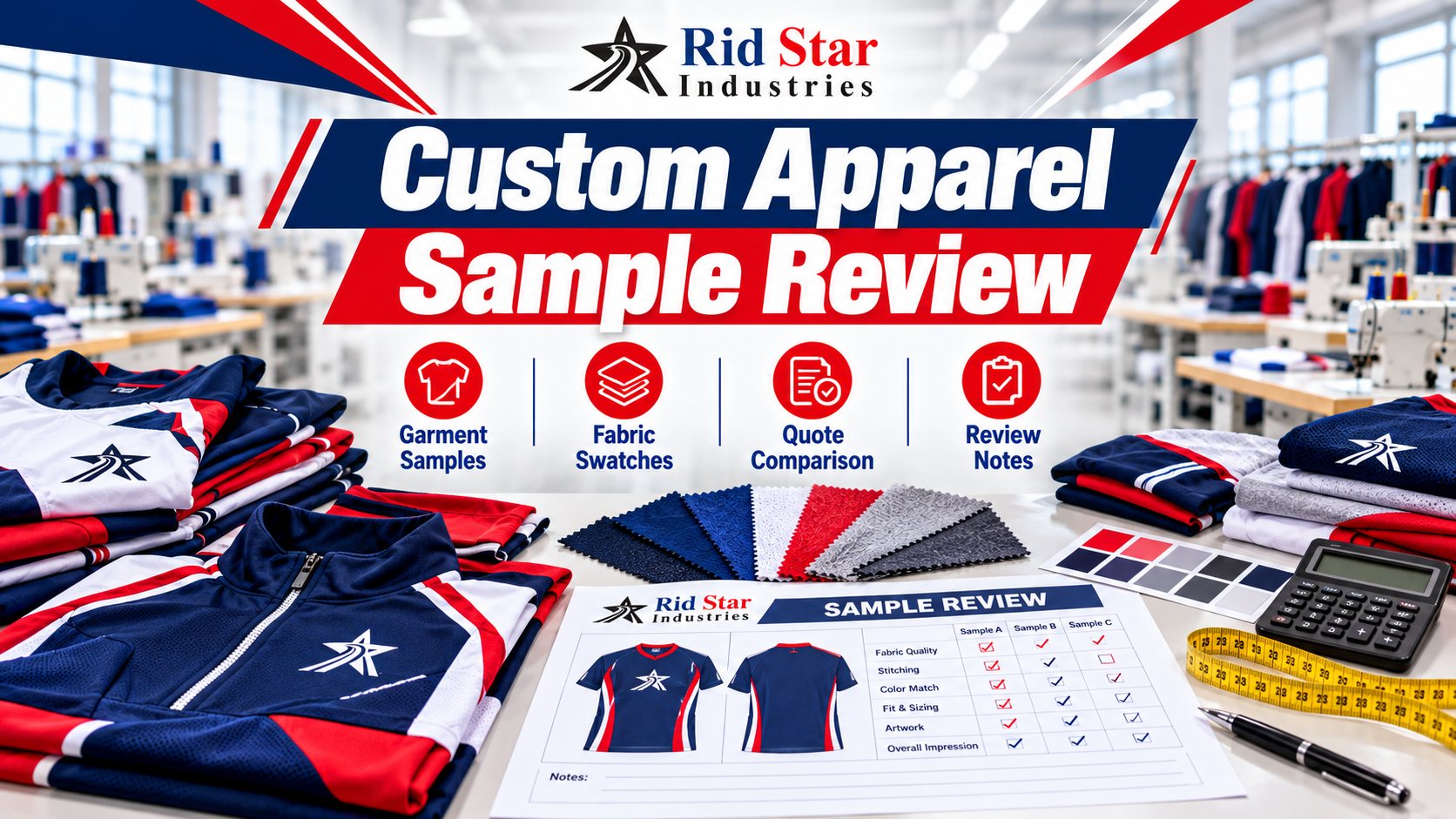
How to Compare Custom Apparel Manufacturing Quotes
Two manufacturers can quote different prices for what appears to be the same garment. Before deciding which offer is better, check whether both prices cover the product and services you actually need.
A quotation for a training shirt might include fabric, stitching and a chest logo, while another also includes individual names, woven labels and separate packaging. Even when both suppliers describe the item as a “custom training shirt,” the order details may differ.
For sports clubs, apparel brands, wholesalers and distributors, a useful comparison makes those differences visible. This guide explains how to compare custom apparel manufacturing quotes and identify what needs clarification before you commit.
Give Every Supplier the Same Order Brief
Start with one dated version of your requirements and send it to each manufacturer. If you change the design or quantity during discussions, share the revision with everyone whose quotation you are comparing.
Your brief should identify the garment, fabric requirements, size breakdown, colours, artwork, decoration locations, labels and packaging. Include the delivery destination and the date you need the goods to arrive.
Specify what counts as one unit. A jersey-only price cannot be compared directly with a jersey-and-shorts set price. For coordinated products, list every garment included in the set.
If you have not settled the material specification, use our guide to choosing fabric for sports uniforms to prepare the questions you need to resolve.
Ask suppliers to identify proposed alternatives separately. A different fabric or simplified design may be worth considering, but you need to see how it differs from your original request.
Check the Quantity Behind Each Price
Record the exact quantity used to calculate each offer. An attractive unit price based on 500 garments does not tell you the cost of your intended 100-piece order.
Provide quantities by style, colour and size. Explain whether every garment uses the same artwork or whether names, numbers and design versions vary across the order.
Clarify how the minimum order quantity applies. The overall garment minimum may not answer whether a particular colour, trim or custom packaging option is available at your requested quantity.
If a supplier offers a lower price for ordering more, request two clearly separated totals: one for your required quantity and one for the larger order. Consider whether you can use the extra stock before treating the lower unit price as a saving.
For activewear collections, our custom activewear manufacturing guide explains how to organise style, sizing and branding requirements before requesting prices.
Separate Garment Prices from Additional Charges
Ask for a quotation that distinguishes the recurring garment price from charges applying to the order as a whole.
Check where the supplier has included artwork preparation, pattern development, sampling, decoration setup, labels and packaging. Do not add a cost twice if it is already included in the unit price.
For personalised sportswear, confirm whether the price covers every required name and number. For private-label garments, confirm whether it includes supplying and attaching the agreed labels.
Sampling deserves its own clarification. Ask what the sample charge covers, whether delivery is separate, how revisions are charged and whether any amount is credited against a later bulk order. Record the conditions rather than assuming a credit will apply.
Use a comparison sheet with a column for each supplier:
| Item to compare | What to record |
|---|---|
| Garment specification | Specification version and any proposed differences |
| Quantity | Pieces or sets, with style, colour and size breakdown |
| Garment price | Currency, unit price and included finishing |
| Development and setup | Separate charges and what each covers |
| Sampling | Sample type, revisions, delivery and any conditional credit |
| Branding and packaging | Included items and separately priced options |
| Delivery | Destination, service and included or excluded charges |
| Timing | Approval requirements, dispatch estimate and transit estimate |
| Quotation conditions | Validity, payment stages and unresolved assumptions |
Mark missing information as “to confirm.” An empty quotation line is not evidence that an item is free or included.
Compare the Cost of the Same Defined Order
Once the specifications match, calculate the total for the quantity you intend to buy.
Consider this illustrative example for 100 training shirts:
- Supplier A quotes $12 per shirt, with $80 for setup, $40 for packaging and $180 for delivery.
- Supplier B quotes $14 per shirt, including setup and packaging, with $140 for delivery.
Supplier A’s quoted total is $1,500. Supplier B’s quoted total is $1,540. The difference is $40 for the order, although the initial unit prices differ by $2.
These are invented figures for explanation, not Rid Star prices or market estimates. The comparison assumes identical garments and the same delivery scope. Any sample charges or destination charges excluded from both offers still need to be considered separately.
Use the same currency and record the conversion date if you convert quotations. Keep estimates clearly labelled until the relevant costs are confirmed.
Clarify Delivery Scope and Production Timing
Give each supplier the same delivery address or destination details. Ask what the quoted delivery charge covers and which costs you would need to arrange or pay separately.
If an offer uses a trade term or shipping abbreviation, ask the supplier to explain the responsibilities attached to it. Do not treat different delivery terms as equivalent because both quotations mention shipping.
Separate production time from transit time. Ask what must happen before the production schedule begins, such as sample approval, final artwork confirmation or an agreed payment.
Also distinguish the expected dispatch date from the required arrival date. For a tournament, launch or school programme, tell the supplier the actual deadline and ask whether the proposed schedule supports it.
Record any assumptions still affecting timing. An estimate based on immediate approval may need revision if the design remains undecided.
Compare Evidence of Product Suitability
Price alone does not show whether a supplier has understood the order. Review the proposed sample, specification responses and explanations of any limitations alongside the quotation.
Check whether the supplier has addressed the details that matter to your product: fit, decoration placement, construction, branding and packing. Ask how these will be checked during production and before dispatch.
When an offer is substantially lower, ask which materials, processes or services explain the difference. A clear answer is more useful than assuming either that the quotation is a bargain or that the product will be unsuitable.
Use the same evaluation criteria for every supplier. Record unresolved questions and obtain revised quotations where necessary before making the final comparison.
Confirm the Final Version Before Ordering
Once you have selected an offer, ask for a final written quotation referencing the agreed specification and quantity breakdown.
Confirm the currency, included costs, exclusions, payment stages, quotation validity and delivery assumptions. Make sure any changes agreed during calls or messages appear in the final record.
Keep that quotation with the approved artwork, sample references and order documents. If you later change a fabric, decoration method, quantity or delivery requirement, ask the supplier to confirm the effect on price and timing before proceeding.
The aim is a clear agreement about what will be supplied, what it will cost and what each party needs to do next.
Request a Custom Apparel Quote from Rid Star
Rid Star Industries is a B2B custom sportswear and apparel manufacturer based in Sialkot, Pakistan. We manufacture sports uniforms, activewear, casual apparel and fitness wear, with custom decoration, private labels and packaging options.
Our minimum order quantity is 10 pieces/sets. Send your proposed product, colour and size breakdown so the available combinations can be confirmed.
Use our quote builder to share your garment requirements, quantity, fabric preferences, customisation, branding, packaging and artwork. Include your delivery destination and required arrival date so these can be discussed with your quotation.