
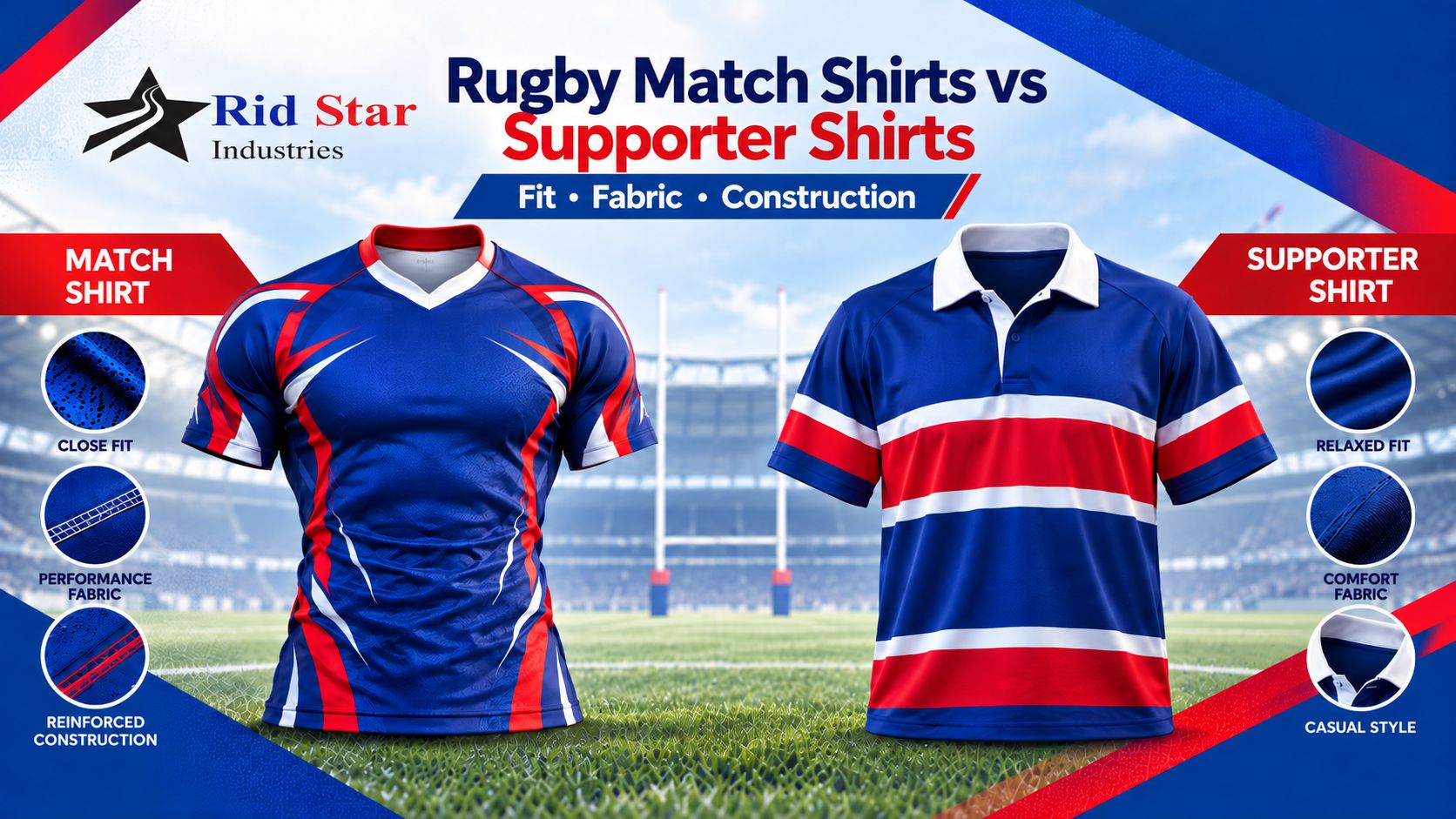
Rugby Match Shirts vs Supporter Shirts: What Buyers Should Specify
A club’s playing shirt and supporter shirt may share the same colours and crest, but they do not necessarily need the same garment specification.
For clubs, schools, sports brands and distributors, comparing rugby match shirts vs supporter shirts starts with identifying who will wear each product and how it will be used. A design mockup shows the appearance; it does not confirm the fit, fabric or construction.
This guide explains what to include in your manufacturing brief when sourcing shirts for players, supporters or both.
Define the Intended Use Before Choosing the Design
Tell the manufacturer whether the shirt is intended for competitive matches, contact training, club travel, supporter merchandise or everyday casual wear.
Avoid relying on descriptions such as “professional,” “replica” or “premium.” Ask what those descriptions mean in the proposed specification.
A supporter shirt may reproduce the playing shirt’s graphics while using a different pattern, neckline or fabric. Equally, a traditional collared appearance does not establish whether a garment is intended for playing or leisure.
If you need both products, create separate specification sheets. Keep the shared branding consistent while identifying the differences deliberately.
| Order detail | Match-shirt brief | Supporter-shirt brief |
|---|---|---|
| Intended wearer | Players and relevant age groups | Supporters, members or retail customers |
| Fit | Agreed playing fit and movement requirements | Agreed everyday fit and layering allowance |
| Fabric | Requirements for the intended playing conditions | Requirements for comfort, appearance and care |
| Construction | Seam, collar and reinforcement details to assess | Finishing suited to the intended everyday use |
| Branding | Team identification and competition requirements | Approved club branding and retail design |
| Size range | Player measurements and team allocation | Target customer measurements and retail size range |
These are specification questions, not fixed rules that every product must follow.
Compare Measurements Instead of Size Labels
“Medium” does not describe the same garment across different patterns. A close-fitting match shirt and a relaxed supporter shirt can carry the same size label while measuring differently.
Request a size chart that clearly distinguishes body measurements from finished garment measurements. Agree how the garment will be measured, including chest width, body length and sleeve dimensions.
For playing shirts, assess the proposed fit while reaching, raising the arms and moving through rugby-related positions. Include the underlayers players expect to wear.
For supporter shirts, decide whether the intended fit is close, regular or relaxed. Consider whether customers are likely to wear another garment underneath.
Do not create the supporter range simply by telling everyone to order a larger match-shirt size. Confirm the actual pattern and measurements for each product.
Specify Fabric Beyond Its Name or Weight
A fabric description should identify more than “polyester” or “heavyweight.” Ask for the proposed composition, fabric construction, GSM and relevant stretch characteristics.
GSM describes fabric weight per square metre. It does not, by itself, establish durability, breathability or suitability for contact play.
Discuss the conditions in which each shirt will be worn. A playing shirt and a casual club shirt may have different priorities, but those priorities should lead to an agreed material specification rather than assumptions.
If moisture management, colourfastness or shrinkage performance matters to the order, ask what evidence is available and how those requirements will be evaluated.
Our guide to choosing fabric for sports uniforms explains the fabric questions to resolve before approving a material.
Review the Collar, Seams and Openings
Identify the required collar or neckline using drawings, photographs or a reference garment. Specify its shape, dimensions and construction rather than approving the appearance alone.
For a shirt intended for playing, ask the manufacturer to explain the proposed seam construction and reinforcement locations. Inspect how the collar opening, shoulder area, sleeve joins and side seams are finished.
Check the sample for uncomfortable bulk, rough edges, loose threads and uneven stitching. Assess the neckline during movement and when putting the garment on and taking it off.
For supporter merchandise, give the same attention to finishing and comfort. A leisure garment still needs clear workmanship requirements even when its intended use differs from the playing shirt.
Avoid treating one stitch type or reinforcement detail as proof that the entire garment will perform as required.
Adapt the Artwork to Each Garment
Shared branding does not mean the same artwork file can be applied unchanged to every pattern.
Different chest widths, collars and panel shapes can affect crest position, sponsor layouts and stripe alignment. Request artwork proofs for each shirt version and check how important elements fit on smaller sizes.
Specify whether each element will use sublimation, embroidery, screen printing or heat transfer. Ask the manufacturer to confirm compatibility with the proposed fabric and placement.
Approve the colour references as well as the digital design. If match and supporter shirts use different fabrics or decoration methods, review physical samples together before agreeing on the acceptable colour match.
For playing shirts, confirm the applicable competition’s requirements for identification, sponsor marks and garment details before final artwork approval.
Keep Quantities and Prices Separate
List match shirts and supporter shirts as separate order lines, even if they share a design.
For each version, provide:
- Product reference and intended use.
- Fabric and construction specification.
- Colour and size breakdown.
- Decoration and personalisation details.
- Labels and packaging.
- Required quantity and delivery destination.
Confirm whether the price covers a shirt only or a set containing additional garments. Keep any sample, setup and delivery charges visible.
Rid Star Industries has a minimum order quantity of 10 pieces/sets. Share the quantities for each proposed version so the available combinations can be confirmed. Do not assume that different fabrics or shirt styles automatically share one minimum.
Approve Each Version Before Production
If the order contains two different garment specifications, approve a sample representing each one.
Review the match shirt against its playing brief and the supporter shirt against its everyday-wear brief. Record the accepted measurements, construction, fabric, artwork and finishing for both.
Agree on any wash checks or performance assessments needed before bulk approval. A visual inspection alone cannot establish long-term durability.
Keep separate product references for future orders. This helps prevent a supporter-shirt specification being mistaken for the playing version when the club reorders.
Discuss Your Custom Rugby Shirt Requirements
Rid Star Industries is a B2B custom sportswear and apparel manufacturer based in Sialkot, Pakistan.
Explore our custom rugby uniform manufacturing service, then share the intended use, quantities, size range, fabric preferences and branding for your project.
If your order includes both playing and supporter shirts, identify each version in your enquiry so its manufacturing requirements can be reviewed separately.